Wednesday, November 08, 2006

The Offensive Gospel


“For though I caused you sorrow by my letter, I do not regret it; though I did regret it—for I see that that letter caused you sorrow, though only for a while—I now rejoice, not that you were made sorrowful, but that you were made sorrowful to the point of repentance; for you were made sorrowful according to the will of God, in order that you might not suffer loss in anything through us. For the sorrow that is according to the will of God produces a repentance without regret, leading to salvation; but the sorrow of the world produces death” (2 Corinthians 7: 8-10).

Whatever else we might say about this passage, this is very obvious: it sounds very contrary to what we would expect a believer to say, especially one like Paul—I caused you sorrow and though I did regret it, I no longer do. There is something in most of us that simply does not like to cause sorrow in others and we certainly do not take the position that when we do, we should not regret it. But this is the position Paul takes in this passage.

Now, let me put Paul’s position in context: he makes it clear that he is not dealing with the sorrow the world brings—sorrow that produces death; instead, he is dealing with the sorrow that produces repentance—the kind of repentance that leads to salvation.

Even this clarification does not, however, simplify the text because even though we have been taught the incredibly good news of the gospel, we have also learned that the gospel is offensive foolishness to those who are perishing! Because of our desire not to repel the perishing by offensive foolishness, we attempt to add things to the gospel that disguise its offensive foolishness and, thereby, make it sound more reasonable and appear more attractive to the perishing masses. Sadly, we have developed this tragic mindset: let us do whatever might be necessary to polish the gospel so that we can reach the masses for Jesus. Whatever we do, let us not hurt anyone’s feelings by causing them sorrow, i.e. by telling them who they really are in the eyes of the Holy God.

Interestingly, however, God designed the gospel for His elect, not for the masses and Paul knew this and he knew it quite well. To be sure, neither Paul nor Jesus did anything to “polish the gospel” in an effort to reach anyone; instead, Jesus identified Himself as “the rock of offense” and Paul did everything he could to bring about Godly sorrow in the hearts and lives of his listeners. His words are clear and distinct: “For the word of the cross is to those who are perishing foolishness, but to us who are being saved it is the power of God” (1 Corinthians 1:18). It was as if both of them were on a mission to discourage rather than encourage followers!

Follow Paul’s line of thought with me: I now rejoice, not that you were made sorrowful, but that you were made sorrowful according to the will of God—sorrow to the point of repentance, the kind of repentance that leads to salvation! I do not think it takes a “rocket scientist” to see this but I will, nevertheless, make my point: no one comes to this kind of repentance until and unless they have been so offended by the gospel that they run to Jesus in utter desperation for redemption and salvation. You see, the gospel is offensive because it reduces man to mere “sackcloth and ashes”—helpless, hopeless, undone, and lost, while at the same time, it elevates God to, well, to God! The gospel is offensive because it brings man to the place where he can no longer worship himself! Isn’t that a novel thought?

Today, I learned that one of the large churches in Macon has asked for the preacher’s resignation. No one had to tell my why because I, well I may be dumb but I ain’t stupid: “The church is going in the wrong direction!” Translated, that means this: “Relative to the other churches in Macon, we are not effectively reaching the masses, so we need another pastor—one who will do whatever it takes not to offend anyone, while at the same time, implementing the kind of programs that will attract more of the perishing masses.” This, however, is my question: what would happen if the leadership of this church took the same position that Jesus and Paul took and simply preached the offensive gospel until it (the gospel) had offended everyone to the very core of their being, until it caused such sorrow that everyone came to repentance, the kind of repentance that leads to salvation?

How in the wide-world have we come believe that we must attempt to improve on the modus operandi of Paul, even Jesus Himself, by making the gospel attractive rather than allowing it to be what it is—offensive?

Thursday, October 26, 2006

PASSION or passion?


Dear Fellow Travelers,

The following is an article that my mother, Naia Goddard, wrote about me; unfortunately, the date is unknown:

Mac’s Childhood

Born: February 15, 1942.

First grandson—everyone delighted.

I was saved before you were 4. I realized the awesome responsibility of where you would spend eternity—I knew I couldn’t do what I needed to do, so I spent a lot of time on my knees—seeking the Lord. He knew the desire of my heart and somehow used my mistakes for your good and His glory. When you wanted to do something I felt like Jesus did not want us to do, I always tried to give you an alternative and let you decide—usually, you decided the right way—(The movie episode; I was taught it was sinful to go to the movie). I took you and Kikky to all day prayer meetings and Bible study—you cut your teeth on the old altars—I guess you learned more than I realized. You accepted Jesus when you were five—you didn’t know anything else—it was our way of life. I guess you were tuned to Jesus as we never had any problems with you; you always wanted to please us. You worked hard at the store; Daddy kept you busy where you had very little free time to get into trouble, if you had wanted to. Ray and I taught the children in Sunday school and Bible school. As you all grew, I worked with the youth—I felt called to do youth work as surely as you have been called to preach. Then all those years we went to camp meeting at Indian Springs. As teenagers, the peer pressure was “if you aren’t a Christian, you aren’t anything.” But we had many decisions for Jesus during those years. So you all just fell in love with Jesus, and as you sang choruses and witnessed for Him, you just grew up and suddenly you’d missed all the “junk” and were rooted and grounded in Him.

As I read this brief bio, several thoughts came to my mind, not the least of which was this: from the moment of my Mother’s justification, she was very, very serious about knowing truth—her desire for it was insatiable. She read and studied the Bible, as if it would be taken away from her without a moment’s notice; she attended Bible studies and prayer meetings several times per week; and she never missed a church service—regardless of which church in the area might have been holding it. As you can probably tell from what she wrote, her early teachers were all dyed-in-the-wool Wesleyan-Arminian regarding their theological persuasion. Because she desperately wanted to know truth, she became easy prey for her “teachers.” Whatever these men (and women) said, she accepted as truth—no questions asked! Unfortunately, men like Calvin and Luther were in their opinions heretics, so she assumed the same posture. As you might imagine, before long, her list of “dos” and “don’ts” was well-formed and seen as the “one-and-only-correct-list.” (As you can see, one of the “don’ts” on her list was “Don’t go to movies because doing so is sin!”) Just for the record: she was very committed and just as determined to obey the list of rules given to her by her teachers, and compared to some, she did it quite well (at least in her mind).

My point is this: I know many people who have embraced the Gospel of Grace just as fervently as my mother embraced the Wesleyan-Arminian “gospel”; however, from what I have been able to see, their continued passion for what they believe doesn’t even come close to the on-going passion my Mother had for what she believed. One would think it would be the other way around! Why is there so much complacency within the lives of those who embrace the true gospel? Why is there such a lack of commitment? Why is there such a lack of participation? We should be the people who are most committed to what we believe but—

Thankfully, several years before her death, my mother saw the error of what she had been taught and she became even more passionate about the Gospel of Grace than she had ever been about the Wesleyan-Arminian heresy. She even burned her “beloved” list of “dos’ and “don’ts” and began to attend movies—even dance! Go figure—

I really pray that you can hear my heart in this—I really do!

Wednesday, October 18, 2006

HAVE YOU CONSIDERED MY SERVANT?


There is a part of Christianity that is, indeed, warm, fuzzy, exciting and incredibly wonderful! For example, have you ever been present when someone was being born into the Kingdom of God? Have you ever seen the power of prayer bring healing to someone you knew and loved? Have you ever been overcome with the excitement and warmth of The Presence of the Holy Spirit? Have you ever attended the ordination of one called by God into the ministry?
I could go on and on; but, suffice it to say that there is that part of Christianity that is warm, fuzzy, incredibly exciting, and outrageously wonderful! However, Christianity has another side that most of us do not like to face—one that is far removed from warm, fuzzy, excitement. Although, I realize that in all probability Job did not know Jesus by name, I think you can see this side of Christianity in God’s dialogue with Satan when He asked him this question: Have you considered my servant Job? There is no one like him on the earth? “And the Lord said to Satan, Have you considered My servant Job? For there is no one like him on the earth, a blameless and upright man, fearing God and turning away from evil” (Job 1:8).
Had you not read the rest of the story, you might think that God was recommending Job for a job promotion with Satan; however, that was not the case because Job was not an employee of Satan! No! God’s question for Job has a way of bringing into focus the truth that most of us don’t want to face, namely, this: Christianity is not what we think it is! It is a far cry from the whitewashed, prosperity-if-you-believe, apple-pie-in-the-sky, no-problems-religion that most of us have been taught that it is!
Just prior to our text verse, we read this: “And the Lord said to Satan, ‘From where do you come?’ Then Satan answered the Lord and said, ‘From roaming about on the earth and walking around on it’” (vs. 7). Let me ask you this: Why does Satan roam around on the earth? He does so because He is seeking someone to devour. Remember 1 Peter 5:8: “Be of sober spirit, be on the alert. Your adversary, the devil prowls about like a roaring lion, seeking someone to devour.”
With that in mind, it is not too difficult to see what Satan was about in his dialogue with God. Interestingly, however, God apparently assisted him in his search! His words were unmistakably these: “Have you considered my servant Job? There is no one like him on the earth!” In other words, God was saying, “If you can get him you to come over to your side, you will have accomplished something huge—really huge!”
Now, let’s be honest: This doesn’t sound like the God we know! Let me say it this way: we hope this isn’t the God we know! The last thing we want to think that God might do is to invite Satan, in his search for someone to devour, to consider one of us. However, it is God (the Father of our Lord, Jesus!) and He did speak these words to Satan: “Have you considered my servant Job? There is no one like him on the earth” (1:8) and He spoke them knowing full well what Satan was about!
He also knew something else! He knew what He was about in Job, and He knew that Satan was under His control! He had a very clear purpose in mind and He was in complete charge!
Now, having said all of that, there are several truths that must come into focus or none of us will be able to handle this text! Without them, I cannot imagine anyone even approaching this text without so much fear and anxiety that they would run from it! Yes! There is a piece of it that sounds exciting: “Have you considered my servant Job? There is no one like him on the earth!” That might well be the highest compliment God ever paid anyone; however, when you realize what Job is being considered for, without the following truths firmly implanted, this passage is very, very hard! (Even then, it is no “walk in the park!”)
First – The sufferings of this present time are not worth being compared with the glory that is to be revealed in us! Listen to the words of Paul: “For I consider that the sufferings of this present time are not worthy to be compared with the glory that is to be revealed to us” (Romans 8:18).
The question seems to be this: Are the blessings of heaven really going to be worth the sufferings on earth that being a Christian brings? At least for Paul, the answer is a resounding – YES! No comparison! The glory that is to be revealed to us when we get home will be so incredibly wonderful that we won’t even have the thought, much less, raise the question.
Now, look with me at 1 Peter 1:6: “In this you greatly rejoice, even though now for a little while, if necessary, you have been distressed by various trials.” Greatly rejoice in what? The blessings of heaven, of course! Look at verses 3-5: “Blessed be the God and Father of our Lord Jesus Christ, who according to His great mercy has caused us to be born again to a living hope through the resurrection of Jesus Christ from the dead, to obtain an inheritance which is imperishable and undefiled and will not fade away, reserved in heaven for you who are protected by the power of God through faith for a salvation ready to be revealed in the last time.”
What is our living hope; rather, who is our living hope? Jesus and all that He has prepared for His elect! Unless you really believe that the “sufferings of this present time” are nothing in comparison to the glory that is to be revealed in us, you will approach this text with so much anxiety and fear that you will run from it. Let me say it this way: You will never personalize it, as you do so many other passages!
Allow me to bring this home: today Satan is roaming about seeking someone to devour! He has not changed, neither has God! Are you prepared for God to assist Satan in his search, and this time to pick YOU out of the crowd for Satan to consider?
Second – It is much better to die and be with Christ than to continue on in this earthsuit, but it is to the advantage of others that we continue here! I know that that sounds a bit morbid; however, it is true because Paul said it: “For to me, to live is Christ, and to die is gain. But if I am to live on in the flesh, this will mean fruitful labor for me; and I do not know which to choose. But I am hard-pressed from both directions, having the desire to depart and be with Christ, for that is very much better; yet to remain on in the flesh is more necessary for your sake” (Philippians 1:21-24).
There can be no mistaking what he said: It would be much better to physically die and be with Christ than to continue on in this earthsuit. We have a hope that does not and will not disappoint us! In my opinion, this is why Paul could say some of the other things he said. For example: “We have this treasure in earthen vessels, that the surpassing greatness of the power may be of God and not from ourselves; we are afflicted in every way, but not crushed; perplexed, but not despairing; persecuted, but not forsaken; struck down, but not destroyed; always carrying about in the body the dying of Jesus, that the life of Jesus also may be manifested in our body. For we who live are constantly being delivered over to death for Jesus’ sake, that the life of Jesus also may be manifested in our mortal flesh” (2 Corinthians 4:7-11). Unless this is firmly planted in you, our text will leave you filled with so much anxiety and fear that you will run from it!
Third – Suffering because you are a Christian, is a privilege and a blessing—a thing of grace—not an act of divine punishment! Paul also said this: “For you have been granted the privilege for Christ’s sake not only to believe in Him but also to suffer in His behalf” (Philippians 1:29; Amp).
Look with me at 2 Timothy 1:8-12: “Therefore do not be ashamed of the testimony of our Lord, or of me His prisoner; but join with me in suffering for the gospel according to the power of God, who has saved us, and called us with a holy calling, not according to our works, but according to His own purpose and grace which was granted us in Christ Jesus from all eternity, but now has been revealed by the appearing of our Savior Christ Jesus, who abolished death, and brought life and immortality to light through the gospel, for which I was appointed a preacher and an apostle and a teacher. For this reason I also suffer these things, but I am not ashamed; for I know in whom I have believed and I am convinced that He is able to guard what I have entrusted to Him until that day.”
We simply cannot get around the fact that for Paul suffering was a privilege and a blessing—a thing of grace—and so it is for you and me! Why? It is because when we suffer because we are His, we are being identified with Him.
Maybe this will help you see it: “And they took his advice, and after calling the apostles in, they flogged them and ordered them to speak no more in the name of Jesus, and then released them. So they went on their way from the presence of the Council, rejoicing that they had been considered worthy to suffer shame for His name” (Acts 5:41). Again, unless this truth is firmly rooted in your life and mind, our text will leave you so filled with anxiety and fear that you will run from it!
Fourth – Suffering is not without divine purpose! Again, Paul probably said it best in Romans 5:3-5: “And not only this, but we also exult in our tribulations, knowing that tribulation brings about perseverance; and perseverance, proven character; and proven character, hope; and hope does not disappoint, because the love of God has been poured out within our hearts through the Holy Spirit who was given to us.”
In Philippians 1:6-7 Paul said this: “For I am confident of this very thing, that He who began a good work in you will perfect it until the day of Christ Jesus. For it is only right for me to feel this way about you all, because I have you in my heart, since both in my imprisonment and in the defense and confirmation of the gospel you all are partakers of grace with me.”
Suffering because we are His is never without divine purpose! God never finds Himself surprised in our suffering – never! No Christian ever suffers outside the parameters of God’s prescribed purpose!
If you cannot see this in the life of Paul, then certainly you can see it in the life of Jesus: His suffering was not without divine purpose. Neither is yours! Unless this is firmly planted in your heart and mind, our text will arouse such anxiety and fear that you will certainly run from it!
Fifth – It is through suffering that we learn obedience! This, too, might be a bit frightening; however, it is true! Believe it or not, it was also true for Jesus. The writer of the letter to the Hebrews said this: “Although He was a Son, He learned obedience from the things which He suffered” (Hebrews 5:8).
The problem with this is that most Christians believe that suffering is the result of their disobedience; however, Jesus was NOT disobedient—even so, He learned obedience from the things He suffered, and, I might add, so do we!
Let’s look at the next verse (9): “And having been made perfect, He became to all those who obey Him the source of eternal salvation. This is even more frightening! He became to those who obey Him the source of eternal salvation!” What is it that we have been asked to obey? The Ten Commandments? Yes! But we have all miserably failed! What then? Job was a righteous man who feared God and hated evil, yet he suffered!
Look at Hebrews 4:9-11: “There remains therefore a Sabbath rest for the people of God. For the one who has entered His rest has himself also rested from his works, as God did from His. Let us therefore be diligent to enter that rest, lest anyone fall through following the same example of disobedience.”
What is the obedience? It is this: Believing that Jesus is enough! Unless this is fixed in your mind, our text will leave you with such anxiety and fear that you will certainly run from it!
Finally – suffering exacerbates our weaknesses and allows His strength to be made perfect in us! From what I have been able to see, we do everything possible to keep from exposing our weaknesses because we do not want others to think we cannot handle life. However, it seems obvious to me that God is determined to expose our weaknesses—whether we like it or not, but He does so with purpose—to show Himself strong!
Listen to the words of Jesus to Paul: “My grace is sufficient for you, for my power is made perfect in your weakness” (2 Corinthians 12:9). Again, unless this is fixed in your mind, our text will leave you with such anxiety and fear that you will run from it!

MYTEXT

“And the Lord said to Satan, Have you considered My servant Job? For there is no one like him on the earth, a blameless and upright man, fearing God and turning away from evil” (Job 1:8).

MY QUESTION

Are you praying that God will do for you what He did for Job and invite Satan to consider you? If not, don’t worry because if He decides to do so, He will do it without your permission. Do remember this: God causes all things to work together for good for those who love Him and are the called according to His purpose!!

I just thought I would give you something to think about in your spare time!

Blessings with grace lavished,

Mac

Friday, October 13, 2006

Friendship


Lately, I have been thinking quite a bit about friendship, and I think I know why—at my age true friends are few and far between. It seems to me that most people, especially those of the Christian variety, treat friendships more like trash than treasures. In my opinion, it is not difficult to recognize that university fraternities and sororities have, historically, done a much better job at developing long-lasting friendships than the church has ever done. Come to think of it, I wonder if anyone has ever done a legitimate study to discover why this is true.
As most of you know from personal experience, the friendships that are born out of university fraternities and sororities are pretty well doused with virtually every variety of immorality; whereas, the friendships that are born out of church interactions are (supposedly) pretty well doused with virtually every variety of morality. Why, then, is the church known for its inability to produce long-lasting relationships, but the university fraternities and sororities are known for their ability to produce long-lasting, even enduring, faithful friendships?
There is a part of me that wishes I had kept a record of the various friendships that I have seen permanently destroyed during my ministry; although, it is probably best that I do not have it because it would serve only to exacerbate the negative feelings I already have. What is so heartbreaking about this is the fact that most of them dissolved over simple misunderstanding—believing something that was not true, not having all the facts, and listening to gossip—as well as things as foolish as taking on another’s offense, attending to another’s business, and of course the lack of nurturing; not to mention, hasty generalizations.
I have personally experienced enough of this to last me for at least one lifetime, if not two. I really would like to know just how many people have chosen to abandon friendship with me for this single reason—they took up another’s offense. Believe it or not but this dual role of pastor/counselor has made me very vulnerable to such relationship losses, and in my opinion, I have suffered this loss far-too-often. I think we can call it “strangulation by triangulation.”
Anyway, the picture at the top was taken in 1960 (maybe 1961) when we were much younger—46 years younger—and much better looking. The suave, young man on the left is Bobby Ray Martin, the nerd in the center is Mac Goddard, and the debonair, young man on the right is Phil Bumpus. I have no idea how it happened but the three of us found ourselves attending Asbury College in Wilmore, Kentucky—at the same time, which we know now was very hard on the college. Now listen: we did not belong to a fraternity, mainly because fraternities were a definite “no-no” at Asbury (and certainly not to a sorority; heck, we couldn’t even hold hands with a girl, much less “sororitize” with her!) but we did attend church, mainly because we were required to do so, the other option being castration; YET, amazingly, I have managed to hold on to these two friends throughout all these years!! No fraternity, much church; yet, still friends! A triangle without strangulation! Is that amazing or what?
Night before last, Phil called me from his retirement home in Missouri, having just returned from a fishing trip in Minnesota, where he caught a boatload of fish and wanted to brag (being the humble soul that I am, I let him do so), and we laughed like two 19 year old boys talking about having just “sororitized” a 18 year old blonde! Can you believe it? This is 46 years after our first meeting (when he really was trying to figure out how to, well, just forget that I said that)!
Today, I had lunch with Bobby Ray at the Old Time Buffet! We picked up right where we left off the last time we met, as if it had been only a few minutes before. We laughed and ate and talked and, well, we did what we have always done—we nurtured our relationship and loved every minute of it!
Based upon “looks” one of these old codgers will die long before me but however it works out, I will always love them, and I will always call them—TRUE FRIENDS!
MY POINT: When you get my age, I hope you have some folk you can call true friend, and I hope you make it to my age!

Monday, October 09, 2006

What IS Today Can Suddenly Change!

October 9, 2006

This past April, my son, Michael, and I played a round of golf at one of the beautiful courses on Hilton Head Island. As you avid golfers know, because we were only a twosome, another twosome was assigned to play with us, but for reasons unbeknown to me, only one of the twosome showed up to play—obviously, a complete stranger. Dick, I soon learned, was a bit older than I and, I might add, a minister, as well. For those of you who know me, you know that I enjoyed that 18 hole journey with him. It didn’t take long for us to become involved in a “round the course” theological discussion, nor did it take long for me to know that we held very similar views, which made it even more interesting! To tell you the truth, somewhere around the 7th or 8th hole, I began to feel as if Dick and I had grown up together in the same small town and had been lifetime friends.

To be honest, I have no idea what my score was for that round but I do remember finishing the 18th hole, realizing that Dick and I would probably never see each other again, and that made the finish of a wonderful round of golf a rather sad time for me. That probably sounds strange to you but for some reason we “clicked” and I hated to think that our paths would probably never again cross. I did ask him for his email address, which he gladly gave to me (of course, I gave him mine, as well). When I returned home, I did not wait for Dick to email me; instead, I emailed him—immediately—and he responded just as quickly. Since then, we have emailed several times and in doing so, we have managed to continue, albeit on a limited basis, what I believe the Holy Spirit began in us last April.

Today, I received another email from Dick and I am going to take the liberty of sharing it with you; I have special reason for doing so: “Mac, Just a quick note to let you know our 43-year old son was killed while riding an ATV late Friday night. We are on our way to Pennsylvania for the funeral. I will be conducting the service and delivering the eulogy with the help of a wonderful minister friend - who was my minister for 30 years. I would appreciate your prayers. Blessings, Dick”

My special reason? I would appreciate your prayers for my friend and for his wife, as they make this painful journey to and through their son’s funeral. Dick is a precious man who truly loves Jesus and who sincerely desires to fulfill his calling, as a minister to the local congregation that has been entrusted to his care. His son’s death will leave a huge void in his heart, one that I don’t even want to attempt to imagine. This mother’s heart will never be the same! Yet, I am certain that the Holy Spirit will use this tragic event to strengthen the message that burns passionately within Dick’s heart; to inspire Dick and his lovely wife to encourage others to live, as if today is their last day; and to motivate Dick to faithfully remind others that what is today can suddenly change and life never again be the same.

Dick, if you ever happen to read this, I want to remind you that I thank God for that special day last spring at Hilton Head, when He brought our paths together and you became my friend. I am honored that you asked me to pray for you! My heart grieves with you and for you, and because it does, I am asking believers from Los Angeles to Boston; from Vancouver to Miami; from Seattle to Cincinnati to pray for you and for you wife, as you process your thoughts and feelings in the coming days, weeks, months, and, even years.

I love you, dear brother! Hopefully, our paths will cross again—soon!

Because of Jesus!!

Mac

Friday, October 06, 2006

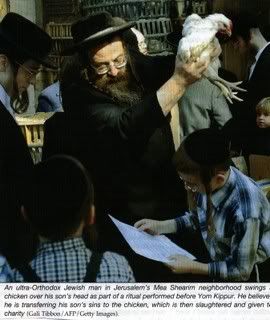
The Waving of Chickens


Most of you are very aware that I am a strong proponent of salvation by grace alone through faith alone in Jesus alone and, consequently, I am very strongly opposed to justification by works—legalism, in any form. I have often tried to warn you and others of the dangers of legalism, and for the most part, I think I have been heard; however, I do know that each of us continues to struggle from time to time with some of the left over remnants of it.

Anyway, I received the magazine, “Israel My Glory” this week and the article that contained this picture captured my attention and for obvious reasons—an ultra-orthodox Jewish father is waving a live chicken over the head of his son, while saying these words: “You are my sacrifice, by whom my sins will be forgiven.” After this ritual is carried out, the chicken is then slaughtered and given to charity!

I can only imagine how things were carried out in Biblical days with the sacrificing of lambs, goats, bulls, even pigeons, but this in my opinion is a very clear example (it takes no imagination) of one of the more significant dangers of legalism—it soon takes us so far away from dependence upon Jesus, that we find ourselves doing what amounts to “swinging live chickens” over our own heads and the heads of others, in our futile attempts to gain Jesus’ love and acceptance. This ultra-orthodox Jewish father is waving a live chicken over the head of his son in preparation for Yom Kippur, which, I am certain, was probably very important for him, but, unfortunately, it was no more effective at having his son’s sins forgiven, than my waving a perfect attendance pin over the head of my grandma would be.

My point is this: I am very thankful that I do not have to depend upon a chicken (dead or alive) for the forgiveness of my sins, nor a goat for that matter. Thankfully, Jesus is my redeemer and He has perfectly and permanently dealt with my sin problem. He has done for me what the blood of bulls, goats, and even chickens could never do—He took my sins away, so far away that God will never remember them again!

Can you see what is so sad in this picture? These Jews are the folk that God calls the “apple of His eye.” These are the folk that Jesus came to redeem; He is their Messiah! Unfortunately, they rejected him and, obviously, they continue to do so, as they wave live chickens in His face!

Careful now! Before you are too hard on them, remember this: in all probability, each of us has “waved our own live chicken” in His face, probably even today, in an attempt to get our sins forgiven; if not, we probably will before the day ends. For some reason, we seem to prefer doing things our own way, rather than submitting to His way. Fortunately, however, His way is the only way that works!

LISTEN! There is but one way to righteousness—JESUS! Neither chickens, ducks, goats, lambs, or perfect attendance pins, even correct doctrine, can take away our sins! Do we sometimes look as foolish as the Jewish father in the above picture?
LET US STOP “WAVING CHICKENS” IN JESUS’ FACE AND, INSTEAD, PLACE OUR TRUST IN HIM!!
Just a reminder—

Thursday, September 28, 2006

Let the Party Begin!

I spent the better part of the afternoon with two of my very dear friends, June and Bill Martin, who are now retired and live in Greenwood, SC with their daughter, son-in-law, and grandchildren. We go back a very long way--over 25 years! Unfortunately, their visit with me was not what you might think; June's mother, Robina Revell, died the other night and they were with me to plan her graveside service, which will be held tomorrow at 2:00 at Macon Memorial Park, a perpetual care cemetery here in Macon. As you might imagine, I will be the "minister in charge!" I never have been quite sure what that term means but I do know that it does mean at least this: I will be in charge of finding words of comfort for these precious friends, as well as finding words of celebration, as we celebrate Robina's life and her homegoing. To be honest, I do not anticipate that being very difficult because these folk know and love the Lord; all I will have to do is lift out a few passages of Scripture and the rest will, well it will just happen. Immediately, several are already coming to my mind, so I am eagerly anticipating what He will do, how He will manifest Himself in our lives at this "place of death."

Acutally, for the elect of God, a gravesite is really not a place of death; instead, it is resurrection ground! (I only wish we could keep that in mind!) Jesus has promised to return for His Bride (actually, I thought it would have been long before now!)and He will do so--you count on that! Anyway, because He made this promise, this apparent "place of death" is actually a place of resurrection! There will be that final day, when God Himself descends from Heaven with the voice of the archangel, the trumpet of God will sound, and the dead in Christ (the "Robinas" who have gone before the rest of us) will rise first, then we which are alive and remain will be caught up together with them in the clouds to meet the Lord in the air and so shall we ever be with the Lord(You can find that in 1Thessalonians, if you care to look)!In other words, when we gather tomorrow at Robina's gravesite, the place where the remains of her physical body will be buried, we will be standing on the same kind of ground upon which Mary Magdalene stood the morning of Jesus resurrection!!

You think about this for a minute: On that incredible morning, everyone, including the devil and all the demons of hell, were convinced that Jesus was dead. The devil was convinced that he had won over good and Jesus' followers were convinced that they had made a bad mistake in following Him. His "borrowed tomb" was for His followers, indeed, a place of death!Then there was Mary! She loved Him and He loved her--make no mistake about it! You remember the story; she approached the tomb about the time that Jesus stepped outside it, thinking that He was a gardner. "Please, sir," she begged, "if you know where they have taken Him, please tell me." Now remember: she was standing on what she thought was burial ground; however, she was mistaken--very mistaken! This supposed gardner replied with a single but all-powerful word: "Mary!" Wow!! Can you imagine that moment? "Raboni," she exclaimed! And they embraced!!

Listen, this IS going to be repeated but this time it will be the likes of you and me, who come forth from our grave! Oh, I am sure there are many skeptics, who believe that what I am writing is a "bunch of bunk" but who cares what they believe? They will be just as surprised as the devil and all the demons of hell were surprised on that first resurrection morning!

Robina has lived with Bill & June for the past 18 years, during which time, they have been her caretakers and her providers. I do not know whether you know it or not but carrying out this kind of responsibility is no easy task, even if it does involve your own mother. It has it own unique ways of sapping one's emotional energy, not to mention physical and mental energy. Toward the end, Robina suffered the ravages of pancreatic cancer, which is a merciless killer. Her body wasted away until it could no longer deal with the suffering and just at the right time, God took her HOME!! Wow!! No longer suffering, no longer having to put up with a worn out earthsuit! At home in her home, home!!

That is right: she is already in Heaven and seated at God's right hand in the Most Holy Place, which in my humble opinion ain't too bad a place to wake up to, from having had to deal with pancreatic cancer!

Now, listen up: this does not preclude her resurrection!! Somehow (and because I am NOT God, I do not understand how), somewhere on down the road, God is going to glorify her worn out earthsuit, and her spirit that is now in Heaven will be united with it and, well, LET THE PARTY BEGIN!!Photobucket - Video and Image Hosting

Amazing grace, how sweet the sound, that saved a wretch like me!!

Tuesday, September 19, 2006

The Love of Christ Controls Us (or does it?)!

In his second letter to the church at Corinth, Paul made this assertion: “For the love of Christ controls us, because we have concluded this: that One has died for all, therefore all have died; and He died for all, that those who live might no longer live for themselves but for Him who for their sake died and was raised” (English Standard Version). Talk about raising questions; even before I can finish typing these words, I am overwhelmed with all the questions Paul’s assertion raises.
“The love of Christ controls us!” He said it under the inspiration of the Holy Spirit, so I know it is true, but sometimes mere casual observation tells me that it must not apply to some of God’s children. If the behavior I have witnessed and experienced from many of God’s children is the result of Jesus’ love controlling them, I can only say, “Thank God that His love is controlling them!” This is my question: What is wrong? If Paul is correct (and he is), then why does it so often appear otherwise?
To be sure, the love of Christ should control us, if for no other reason than we have been the recipients of it. We deserved anything but His love; yet, He has poured it out upon us without measure. Why, then, do we behave the way we do? Why doesn’t His love control us? (Maybe I should say it this way: Why do we live as if His love has no influence or control over us?) If His love really controls us, wouldn’t our tongues speak differently? If His love really controls us, wouldn’t we care more for the other person, than we care for ourselves? If His love really controls us, wouldn’t we be less influenced by the mirrors of a thousand, religious opinions? If His love really controls us, wouldn’t we be less prone to allow others to define obedience for us? In my opinion, if His love really controls us, many aspects of our lives would be very different!
Paul then gives his reason for his assertion: because we have concluded that One has died for all, therefore all have died; and He died for all, that those who live might no longer live for themselves but for Him who for their sake died and was raised. I think most of us will agree that One has, indeed, died for us, and in doing so He demonstrated the aforementioned love that controls us. However, he said that this One died for ALL, and I know that this raises the same kind of questions for most of us that the idea that “His love controls us” raises. If He really did die for all (everyone), then why are some going to Hell, not to mention, why isn’t everyone controlled by His love? I am definitely NOT a universalist (everyone is going to Heaven), so I have to believe that there is more here, than a casual glance can see. Why would Paul (of all people) even hint that Jesus died for everyone, when in fact He did not die for everyone?
Finally, Paul gives the evidence that demonstrates that the love of Christ controls us and it is this: those who live as the result of His death and resurrection, no longer live for themselves but for Him who for their sake died and was raised! Obviously, not everyone lives as the result of His death and resurrection, which is good evidence that He did not die for everyone; however, says Paul, those who do so live, live not for themselves but for the one who died and was raised for them, which just might be the most difficult part of this passage. Why? Well, from what I can see, most of us live for ourselves (even when on the surface we seem to be doing otherwise, e.g. visiting the sick), having little or no interest in living for the One who died and was raised—Jesus, to be specific.
There is another noteworthy “twist” to this idea of the love of Christ controlling us and it is this: When God places us in adverse situations, or when He intervenes in our decision making processes, or when He, simply, overrules in our lives by not allowing us to have our way, His love is controlling us. No, it might not look like, quack like, feel like, or waddle like the love of God but in fact, it is His love—every time and all the time! Be thankful; otherwise, who knows what we might be doing! However, do not be misled: because God has chosen for us to live in a loving relationship with Him, I do not think He is using His love to somehow twist our arms until we decide to live for Jesus and not for ourselves. This would negate the entire idea of relationship and leave us a mere puppets.
Anyway, regardless of how we cut this “pie” we cannot get away from the fact that the love of Christ controls us; however, neither can we get away from the fact that controlling love is an oxymoron. Well, almost, that is. If my love is controlling you, then I do not love you—period! If your love is controlling me, then you do not love me—period! In Christian marriage, if one mate’s “love” controls the other, then that mate’s “love” is really not love at all. But then, the text says that THE LOVE OF CHRIST controls us, not our love for one another, and there is a difference!!
You see, God is, well, He is God and, therefore, His love is perfect; consequently, His love must control us; otherwise, His love is really not love at all! If God’s love does not control us, then we are in heaps of trouble—serious trouble! If His love does not control us, then no one would ever be born of His Spirit! If His love does not control us, then we would have no clue as to the significance of our being recipients of such love! To be sure, if His love does not control us, then each of us will live ONLY for ourselves.
You think about this—

Friday, September 08, 2006

Marriage, Divorce, & Remarriage Part Final

Last week, I ended my article with this bit of encouragement: “If you are one of those who, thankfully, divorced after living (incarcerated) in a controlling marriage, but you are finding it difficult to enjoy your newly-discovered freedom, take heart! God never leaves His children in in the bondage of slavery (it was for freedom that Christ set us free!), so you can rest assured that He predestined you for this freedom, and, I might add, there is nothing better than His present provision for your life—absolutely, nothing—not fish, cucumbers, melons, leeks, onions, or garlic (whatever they might represent in your life!).”
In other words, whether you choose to remain single or to remarry, God has a new life for you, a life that, on the one hand is terribly frightening, yet, on the other hand, even the thought is exhilarating, giving you the kind of rush I think you would feel just before you made your first bungee jump off the Golden Gate Bridge, hoping you would stop short of the school of piranhas that were eagerly greeting you.

The fact is you stand in one of those God-designed places where you can know better than you have ever known not only that you have died (you no longer live!) but also that Jesus is your life. You have been bought with a price and, therefore, are not your own! What an incredible place to have landed after such an gut-wrenching journey! As I see it you have landed on a precipice, a very high, vertical cliff, and your only way out is a free-fall jump! Sounds just like God, doesn’t it?

Now listen to these words from “Deep Unto Deep” by Dana Candler (p. 143-145): “. . . in my descent, a drawn out cry comes forth as my last request, “Have Your way!” Into His hands, I commit my spirit (Ps. 31:5). I have died, and I no longer live. I have no more rights. Swallowed up in the great deep of my transcendent God, fully His forever. I have taken His name, and my entire identity has been absorbed by Himself. I freefall with arms spread wide, holding nothing for myself and keeping not the slightest grip of ownership upon my life. My life is not my own. I have been bought with a price. And I have willingly surrendered to my position of hiddenness in Him—hidden with Christ in God. When we leave the places of living before men and begin to live before the Eyes-of-fire alone, we cross over into unknown territory. He has brought us to a certain wilderness of transformation. And here in this place we are no longer able to measure our worth by the tangible reality of our success before men. We leave the old measuring sticks at the door, for they are not suited for the ways of God. We depart from the false identity that was based on how respected, known, gifted, and influential we were in the eyes of men and leap into the vast unknown realm, the hidden reality, of who we are eternally in God. In this hurdle, we take great risk for we leave every familiar comfort behind us. To abandon the realm of the seen that we might freefall into the unseen is a daring endeavor and only faith anchors our souls. We voluntarily jump off the cliff of our old identity without an absolute clarity of our new one. Though we know who we are in the corporate sense of the redeemed-body-of-Christ, the mysteries that He formed in us individually and the details of who we are personally in the hidden places, are nearly entirely hidden from our understandings. We are trading in what we have always known and what others have always told us of ourselves for a book of blank pages. We leave all the old voices, however true or false, for the One voice who is temporarily very silent in our experience. He shows us so little of who we are in Him in the beginning because He wants us to experience the ‘drop off’ from the old ways and be willing to plunge into the unseen realm with eyes of faith. We face the pain of the barrenness of our souls. We face the reality of all that we do not yet know of Him, when we once thought we knew so much. We spend a season in this dangling-in-between place—no longer identified as we once were, yet still so foreign and distant from who we truly are in Him and our eternal identity. As we dangle, we pray, ‘Let me be weighed on honest scales, that God may know my integrity’ (Job 31:6).”

Let me be honest: I am scared-to-death of heights, so you can rest assured that I ain’t going to bungee jump, even from a barstool, much less a bridge, so I am certainly not going to choose a freefall jump from a cliff! Interestingly, however, God has His own ways of “landing” us in that place where our only way out is a freefall jump into the unknown. Fortunately, however, we do get to make that “one last request”—”Have Thine own way!”—but even that is a bit nerve racking.

Now, let me be even more honest. I think this author (Dana Candler) is unveiling something and I really want you to see it: Even though it makes you hyperventilate, it IS safe to make the freefall jump into the wilderness of transformation, into that high and holy place where the Holy Spirit, not men, determine obedience for you. You see, in your jumping you leave behind those old measuring sticks—how respected, known, gifted, and influential you were in the eyes of men—and trade them in for a book of blank pages, or so they seem. Thankfully, God has already written the script but He did so with white ink on white paper. To use the words of Dana Candler, “No one, except those rare few with eyes into eternity can perceive who we are anymore.”

So, go ahead and jump; it really is safe! Whether you choose to remain single or at some point to remarry, the best is yet to come, and that is a promise (from Him, not me!). At least, once you make the jump, you are no longer controlled by the mirrors of a thousand religious, self-centered opinions and that, my friend, is quite a measure of exhilarating freedom!
Thanks for all your patience in reading these bits and pieces of “literary genius” from this old codger, who knows very well that he not only knows very little, but also that what he knows is probably a far-cry from the real truth! Let us continue seeking Him, whom to know is eternal life!!

Marriage, Divorce, & Remarriage Part XVI

FISH, CUCUMBERS, MELONS, LEEKS, ONIONS, AND GARLIC

Last week, I ended my discussion with these words: In spite of all the fears and the ensuing anger, some do finally make it to freedom and when they do, well, all kinds of new emotions begin to surface (really, old emotions dressed in different garments) making even freedom a scary thing, much as it was for the black slaves of old. The signing of the Emancipation Proclamation set the slaves free—legally free—but it did NOT teach them how to live in freedom. Many of them walked off the plantations where they had been held in slavery, but the new emotions they began to feel (old emotions dressed in different garments) had them second-guessing themselves at every turn. Unfortunate, but true. Thankfully, it was for freedom that Christ set us free, therefore (to use the words of Paul), do not be subject again to a yoke of slavery!

When it comes to divorce, this second-guessing begins long before the divorce is finalized; however, once the person steps into the land of “freedom” it kicks into another gear, or to use the words of Emeril Lagasse, another “notch!” In fact, it often comes much like a landslide, in the form of “what-ifs” and “should haves.” “What if I had been more patient,” or “I probably should not have been so hard-lined,” or “If I had waited a little longer, we could have probably worked it out,” or “If I had just trusted God more, He would have changed my heart,” ad infinitum. In the long-run, this second-guessing is probably normal; it is probably our attempt at reassuring ourselves that we did the “right” thing, especially in light of the terrible stigma that has been placed upon those who divorce. So, if you see yourself here, just take it easy; give yourself time to adjust, to settle-in, and to discover at a deeper level than you have ever known, that His strength really is made perfect in your weakness. Remember: when you have the Creator of the Universe standing by your side and ON your side, all the “what-ifs” and “should-haves” you could ever list, really carry little consequence—He is in charge and in control every time and all the time.

Now, as to this notion of learning to live in this new-found freedom, something very familiar comes to my mind—fish, cucumbers, melons, leeks, onions, and garlic. You are very familiar with the story but listen to these words: “Now the people became like those who complain of adversity in the hearing of the Lord; and when the Lord heard it, His anger was kindled, and the fire of the Lord burned among them and consumed some of the outskirts of the camp. The people therefore cried out to the Lord, and the fire died out. So the name of that place was called Taberah, because the fire of the Lord burned among them. And the rabble who were among them had greedy desires; and also the sons of Israel wept again and said, ‘Who will give us meat to eat? We remember the fish which we used to eat free in Egypt, the cucumbers and the melons and the leeks and the onions and the garlic, but now our appetite is gone. There is nothing at all to look at except this manna’” (Numbers 11:1-6; emphasis, mine).
As you well-know, the Israelites had been in bondage to the Egyptians for many, many years but God heard their cries and chose to deliver them out of Egypt and from slavery (God never leaves His children in slavery!) AND to lead them into Canaan, a land flowing with milk and honey—the land of freedom. Furthermore, He chose to be their provider and to see to it that they had everything they needed in this new-found freedom; HOWEVER, God’s provision soon lost its appeal and they found themselves grumbling and complaining, not to mention, wandering aimlessly in the desert.

Manna was neither fish nor cucumbers nor melons nor leeks nor onions nor garlic; in fact, unlike any of these, manna was perfect food but its appeal was, well, compared to these, it was not very appealing. Before long, the grumbling and complaining became a very clear and angry cry: “Oh that someone would give us meat to eat! For we were well-off in Egypt.” Did God respond? You bet He did and these were His words: “You shall eat, not one day, nor two days, nor five days, nor ten days, nor twenty days, but a whole month, until it comes out of your nostrils and becomes loathsome to you; because you have rejected the Lord who is among you and have wept before Him, saying, ‘Why did we ever leave Egypt?’”
Hopefully, at this point something very specific is becoming very obvious to you and I can only trust that it is this: the Israelites had to learn how to live in their newly-discovered freedom, even how to enjoy it! Contrary to what they thought, they were NOT well-off in Egypt; instead, they were slaves to those whose only purpose was to use them for their own selfish ends. Their question, “Why did we ever leave Egypt?” is the tell-tale sign of just how difficult it is for those who have been living as slaves to learn to live in freedom!

If you are one of those who, thankfully, divorced after living (incarcerated) in a controlling marriage, but you are finding it difficult to enjoy your newly-discovered freedom, take heart! God never leaves His children in in the bondage of slavery (it was for freedom that Christ set us free!), so you can rest assured that He predestined you for this freedom, and, I might add, there is nothing better than His present provision for your life—absolutely, nothing—not fish, cucumbers, melons, leeks, onions, or garlic (whatever they might represent in your life!).

“So let us know, let us press on to know the Lord,
His going forth is as certain as the dawn;
And He will come to us like the rain,
Like the spring rain watering the earth”
(Hosea 6:3).

Tuesday, August 29, 2006

Marriage, Divorce, & Remarriage Part XV

Well, the murder/suicide is history, the post-mortem examination is complete, and the results are as expected—the perpetrator contained very high levels of various toxins, each of which was the fruit of self-centeredness. Regardless, however, of the reasons, both perpetrator and victim begin to experience the pain of loss—significant loss, especially if the marriage lasted past the honeymoon stage. Enter grief!

Grief is essential, if a healthy lifestyle is to ensue; however, it is oftentimes a very difficult journey. The elements (denial, guilt, anger outward, anger inward, depression, resolution, etc) are predictable but they do not always present neatly packaged; consequently, many refuse to make the journey to healthy living and, therefore, find themselves locked in the prison of anger, bitterness, resentment, and, even, clinical depression—futilely trying to “get even” or to get back what they lost. In the end, these become enslaved to the one(s) they blame for their loss, spending every waking moment trying to figure out not only how to get back what they lost, but also how to get back in control of the one(s) they no longer control.

In many instances, this murder/suicide precipitates divorce, the legal end of a marriage that in most cases has long-since died. In my mind, the divorce decree is much like a death certificate, in that it serves as legal evidence of the death of the marriage. It is usually very difficult to get those involved to see this; however, it is true: in most instances, marriages die long before anyone mentions the word “divorce.” Sadly, this is true because the church has placed such a stigma on divorce, one that causes people to remain in dead relationships, even long after decomposition is complete, and that is far too long.

For most Christians, deep, long-standing convictions also become key players, players that make making the decision very, very difficult. The sincere desire to obey God and to please Him in all things make such convictions as “God hates divorce” and “until death separates us” and “what God hath joined together, let no man put asunder” and “God cannot bless willful disobedience” and “thou shalt not commit adultery” powerful deterrents to divorce, which is why so many choose to remain in marriages long after the vows have been broken and life has ceased.

Sadly, most never seem to learn the truth that Paul proclaimed—the letter kills but the Spirit gives life—consequently, they spend entire lifetimes futilely attempting to please God (who, thankfully, is already pleased) by remaining in their “dead” marriages, only to become modern-day Pharisees.

Thankfully, however, there are those who do come to realize that we (Christians) have been called to live, not according to the letter of the Law but according to the leadership of the Holy Spirit—the difference between living under the Old Covenant of Law and the New Covenant of Grace. These are the ones who finally come to realize that they no longer have to allow others to define obedience for them and can, therefore, view divorce as a gift of God’s love, rather than as His curse.

Now, make no mistake: divorce IS difficult—very difficult—not only for both parties but also for other family members and friends. There is no short-cut, no easy way out; instead, it is gut-wrenchingly painful. Even when both parties agree that divorce is the best option for them; it is none-the-less painful. Emotions run wild, with fear and anger being the dominant players, even in the lives of those who sincerely believe that divorce can be a gift of God’s love.

From my experience, one of the greatest fear-factors is the fact that obtaining a divorce most often means hiring an attorney (or attorneys, as the case may be) at great expense, only to find that once matters enter into the legal system, both parties lose any and all control over their futures. Of course, circumstances do make a difference, e.g. when children are involved or when large amounts of money or property are at stake. After years of being involved as a marriage counselor, I have seen the system make decisions that were devastating and altogether unfair. I can remember examples that I simply could not believe were taking place in a court of justice! To be sure, there is no wonder that most will endure any and all kinds of malevolence, even abuse, before choosing to place their lives into such an incredibly insane system.

Obviously, another of the deterrent fear-factors is the concern that is often expressed with these all-too-familiar words: “I cannot make it alone—emotionally, financially, or spiritually.” To be sure, for some to take life on alone is quite a challenge; however, living in a dead relationship is an even greater challenge. The problem is this: we tend to grow comfortable in our long-standing misery; whereas, the uncertain future appears to be very uncomfortable, at least, that is, until God makes us desperate for life—like a drowning man is desperate for air. Of course, the spouse who does not want the divorce tends to exacerbate this fear with comments such as, “You know that you cannot survive financially without my help” or “You know that you cannot make it alone as a single parent” or “You know that you know nothing about finances” or “You can’t even change a light bulb.”

In spite of all the fears and the ensuing anger, some do finally make it to freedom and when they do, well, all kinds of new emotions begin to surface (really, old emotions dressed in different garments) making even freedom a scary thing, much as it was for the black slaves of old. The signing of the emancipation proclamation set the slaves free—legally free—but it did NOT teach them how to live in freedom. Many of them walked off the plantations where they had been held in slavery but the new emotions they began to feel (old emotions dressed in different garments) had them second-guessing themselves at every turn. Unfortunate, but true—

Thankfully, it was for freedom that Christ set us free, therefore (to use the words of Paul), do not be subject again to a yoke of slavery!

Friday, August 18, 2006

Marriage, Divorce, & Remarriage Part XIV

Believe it or not, back in the 1980’s, I actually served two terms as the coroner of Taylor County, that’s right—The Coroner of Taylor County! It was during this experience that I became very familiar with the term “toxicity” and for this good reason: many of the dead human bodies that fell under my jurisdiction found themselves in the medical examiner’s office, undergoing what is known as a post mortem examination, aka an autopsy, and, almost without exception, I requested a “toxicology” report from the medical examiner. The purpose of this report was to let me know both qualitatively and quantitatively of the “toxicity” of the deceased’s blood, that is did it contain drugs (legal or illegal) and if, yes, what were their levels. Obviously, this information was essential when it came to determining a cause of death, as well as the manner of death. As you might imagine, when a report came back to me indicating that the test was positive for drugs of any kind, especially at toxic levels, it influenced the outcome of the Coroner’s Inquest, be it death by natural causes, by accident, by homicide, or by suicide. As you can now easily see, in the Coroner’s world, the term “toxicity” has the stench of death all over it.
As strange as it might seem, to the marriage counselor, the word “toxicity” carries a very similar stench. If I had a post mortem examination for dead marriages (now that I think about it, I should develop one!), we would all probably be amazed at the percentage of them that would show very high levels of toxicity, and, I might add, the “toxins” would be very easy to identify—neglect, abandonment, emotional insulation, lying, cheating, insensitivity, lack of respect, perfectionism, control, invalidation of feelings, unrealistic expectations, insecurity, lack of boundaries, lack of transparency, lack of goals, and laziness, just to mention a few.
In my opinion, there is one heading under which all of the “toxins of marriage” fall and it is this: SELFCENTEREDNESS. In other words, the cause of death that should be shown on the Certificate of Divorce is always self-centeredness, and it is so because self-centeredness prevents any sense of connectedness—emotionally, physically, and spiritually—without which, there is no life. Attempting to have a viable, healthy marriage without this connectedness is about like attempting to survive as a human without water, oxygen, and food.
On the other hand, the manner of death is murder/suicide! Almost always one of the partners begs for this connectedness but the other (because of self-centeredness) exhibits most, if not all, of the above toxins, thereby, making the relationship toxic, and slowly but surely he kills the other and, thereby, commits marital suicide.
Let us think for a minute about the wife, who for years pleaded with her husband to be a listener instead of a controller, to be a responder instead of a reactor, to spend time with her, to show interest in her life but, instead, had to endure various affairs (I am reminded of the young wife, who told me of three of her husband’s affairs), continuous neglect (I am reminded of the wife who told me that she would much rather be her husband’s golf clubs than his wife because he took so much better care of them), debilitating control (I am reminded of the many wives, who have presented to me as non-persons due to their husband’s relentless control over their lives), demeaning perfectionism (I am reminded of the countless wives, who have told me of their incredible frustration with marriage because they can never do anything “right”; try as they may, they can never measure up to the invisible standard that seems to be ever increasing), unrealistic expectations (I am reminded of one of several wives, who told me of her husband’s long-standing refusal to have sex with her, unless she defecated on him, even if doing so required the use of an enema), long-standing invalidation of feelings (I am reminded of one wife in particular, who told me of her husbands continuous and long-standing “trashing” of the things she treasured, such as church and relationships), and, finally, her own emotional insulation (I am thinking of the countless wives whose husband’s were alcoholics, and in an effort to survive they learned to hide their feelings by putting a wall of emotional insulation around themselves—a wall that kept others out and at the same time kept them “in.”
Yes, this wife finally came to her senses and admitted the obvious: her husband had long-since committed the aforementioned murder/suicide and the cause of both was his self-centeredness. No, she was not perfect in her responses to his self-centeredness (who would or could have been?!) but she was genuinely interested in being his wife, in being his helpmate—the rest of him UNTIL she woke up to realize the obvious and painful truth—his interests in her were not, nor had they ever been for that matter, FOR her and her well-being; instead, his interests were completely self-serving! Just for the record: the ultimate act of self-centeredness is murder/suicide!
IF I had my post mortem examination for dead marriages ready for use and performed it on this one, I think it is obvious that the toxicology portion would indicate very high levels of TOXICITY—affairs, neglect, control, perfectionism, unrealistic expectations, invalidation of feelings, and emotional insulation—that would clearly demonstrate the self-centered nature of the perpetrator.
Poison is poison and poison kills—eventually—

Marriage, Divorce, & Remarriage Part XIII

Hopefully, you remember my telling you about my friend’s (the very successful hedge fund trader) telling the desk clerk to give me the key to my room’s bar. At first, I wasn’t even aware that this was an option for me (I did not so much as know that the room had a bar) until the desk clerk made me aware, but, even then, I declined it; however, my friend intervened and instructed the clerk to give it to me, which he did. At that point, I had received (albeit, reluctantly) my option to drink freely from the bar that was in my room; however, as I told you last week, I never exercised my option—I never even opened the bar’s door. (I am still wondering why I did not, especially, in light of the fact that it would have cost me nothing! Maybe I will get another chance!)
Anyway, I reminded you of that story, in order to continue my discussion on the subject of “options” as they apply to Christian marriage. If you remember, I pointed out that many Christians, who are living in troubled marriages, are convinced that they have no option, other than of course the “until death separates us” option, and, therefore, they feel trapped. On occasion, I do meet someone who is aware of a good and viable option, one that is, actually, being offered to her, but most often she has already determined that she cannot accept it, certainly not as a personal possibility, usually due to religious teaching. As I said earlier, it is one thing to be convinced that you have no viable options, but it is even worse to know that a good and viable option is being offered to you, but you are not allowed to receive it, especially when you know that doing so would set you free.
Then, the saddest of all: the occasional person who does receive a good and viable option, as a personal possibility (for the sake of our example, let us use divorce), but cannot bring herself to exercise it. Most often, this comes as the result of having been controlled, even brainwashed, by religious (albeit, sometimes well-intentioned) teachers—parents, grandparents, pastors, Bible study teachers, Sunday School teachers, ad infinitum—to the extent that any thought that falls outside the parameters of their teaching, seems to be an heretical thought, one to be rejected at any cost.
Obviously, it was a major undertaking for this person merely to receive the option of divorce as a personal possibility; consequently, you can bet that exercising it will require incredible courage, the kind that says, “I choose no longer to be controlled by another’s belief system; consequently, I will no longer allow someone else to define obedience for me.” These, although few and far between, are the people who finally discover the freedom and rest that is provided in Jesus! Yes! Sometimes, the door to that freedom is called “DIVORCE” believe it or not!
Think with me for a few minutes about this individual: She finally admits to herself (or to someone) that she is living in a miserable marriage (a huge step for her because she is well-schooled in the fact that doing so will in all probability make her THE problem). Interestingly, however, this simple “admission” opens the door for her to begin to face the many issues that she has long-since suppressed—rejection, control, blame, anger, abandonment, fear, ridicule, and invalidated feelings, to mention a few. As you might expect, as each issue is faced and validated, her emotions run wildly across the entire emotional spectrum; however, as you might not expect, she tends to find ways to blame herself for each issue. After all, this is the way she has been taught to respond, not only by her religious teachers, but also by her controlling spouse. It is the all-too-familiar mindset that says, “If you think contrarily to the way I (we) think, you are wrong—dead wrong.” Unfortunately, it usually takes quite some time, even for the best of counselors, to decompress those “pinched nerves” and, I might add, it takes even more time for her ability to feel to return, but when it does, things change—drastically! She no longer sees herself as THE problem but as a victim and, consequently, she immediately begins to take ownership of her life, but doing so, is quite the challenge because those who have controlled her for so long cannot tolerate, even for a moment, the thought of being out of control.
As you might imagine, at this point her controllers become very creative and do whatever they can imagine (and then some) to keep her fenced within the parameters of their control. Of course, the controller who has most to lose (in our example) is her spouse; consequently, he begins to demonstrate what appear to be two distinct people—kind and gracious one minute but angry and hurtful the next. Obviously, his overriding concern is not her but his lack of control over her, so he does the only thing he knows to do to keep from losing control—try desperately to keep her imprisoned in the marriage. Unfortunately, he cannot hide his anger but he surely doesn’t want to unleash it onto her (doing so would not promote his agenda), so he begins to target his anger away from her and toward others (anyone who doesn’t side with him), especially toward those who helped her to realize that she does have the good and viable option of divorce.
As you might expect, about all this targeted anger accomplishes is to diminish (even further) any possible chance of restoration, and he realizes this, usually early on, so he changes his tactic and begins to target those who he thinks might have strong influence for his cause. Though they aren’t aware of it, his targets become anyone who will listen to his poisonous mouth and give credence to what comes out of it. As you might imagine, this serves only to backfire and bring the kiss of death. Had there been even the slightest, flickering flame of hope for marriage reconciliation, this kiss of death extinguished it—forever.

Tuesday, August 08, 2006

MARRIAGE, DIVORCE, & REMARRIAGE WITHIN THE CHRISTIAN COMMUNITY Part XII

Last week, I wrote about two of the factors, that in my opinion have played significant roles in the downfall of Christian marriage—“denial” and “pretense.” Hopefully, that discussion was meaningful to you. This week, I want to ask you to think with me about two additional factors which (again, in my opinion) have made just-as-significant (if not more so) contributions to the downfall of Christian marriage—”options” and “toxicity”.
I have a friend, a very successful hedge funds trader, who, as you might imagine, is constantly dealing with “options.” Not long ago, as he was checking me into a very nice hotel (with his credit card) in St. Petersburg, Florida, the clerk at the desk asked me if I wanted the key to the room’s bar. Trying to follow my Mother’s teaching about etiquette (if you can believe that about me), I declined it and when I did, my friend turned to the desk clerk and said, “No, no; give him the key.” As we walked away, he said to me, “Always take your options; you might not plan to use them but at least you have them, should you change your mind” (I guess this is the way successful hedge fund traders think). Anyway, I walked away with the key to the bar in my pocket, having received my option to drink all the whisky, gin, rum, vodka, and beer I could ever want and then some, at no cost whatsoever to me; HOWEVER, I never exercised the option (I never even stuck the key into the lock on the door of the bar! Now I wonder why I didn’t! I think my Mother was looking over my shoulder!).
Interestingly, when I got back home, I realized that this bar key was in my shaving kit; I can only assume that it is my reminder to always take my options, just in case I do decide to exercise them. It is one thing to be offered an option; it is another to take (receive) the option; but it is quite another to exercise it, and, I might add, this is especially true in troubled marriages!
Now, when it comes to troubled, Christian marriages, most of the couples I have counseled seem to be completely convinced that they have no viable options; therefore, they feel trapped. Occasionally, I meet someone who is at least aware that an option is available, but, inevitably, he/she has already refused to receive the option as a personal possibility. Needless to say, of the few who do receive the options that are offered to them, even fewer ever exercise them, even their God-given options (remember the bar key?). Think with me—
From what I have seen and heard, it is obvious that many (too many) of the Christians who live in troubled marriages, fall into the first category—completely convinced that they have no options, other than (of course) the option to tough-it-out until “death alone separates us”, that is, if they plan to remain in good standing with their families, the church, with other believers, and with God. Unfortunately, most (probably all) of these arrived at this devastating mindset through the teachings they have received from the church, and (I might add) they are easily recognized by their obvious paralysis—emotional paralysis, that is. In other words, over time they become convinced that it is much safer to suppress their feelings (frustration, resentment, bitterness, anger, doubt, loneliness, hurt, confusion, and rejection, to mention a few) and maintain the status quo, than it is to express them and, thereby, become THE problem (both at home and at church); consequently, they stop allowing themselves to feel—paralyzed emotionally—and, thereby, lose their own “person.” Thankfully, God does raise the dead!
Occasionally (only after resurrection), I do meet someone who realizes that a good and viable option is being offered, but (sadly) something deep within causes her to feel that she cannot receive it (the way I felt when I was asked if I wanted to accept the key to the bar). What is this “something” that causes her to feel this way? Isn’t it obvious? Her religious training has taught her that she should not accept it (old mindsets) because doing so would somehow successfully tempt her to “break the rules” that she has allowed others to impose upon her, and that, at least in her mind, would be the equivalent of spiritual suicide! In the end, the result is the same for her, as it is for the one who is convinced that she has no options, with this exception: increased suppression of the feelings of frustration, resentment, bitterness, anger, doubt, loneliness, hurt, confusion, and rejection. You see, it is bad enough to be convinced that you have no viable options, but it is even worse to know that a good and viable option is being offered to you, but you are not allowed to receive it, especially, when you know that doing so would set you free.
Then, occasionally, I meet someone who will receive the option but then refuses to exercise it—talk about frustration! One wonders if some just, simply, prefer misery!
(continued next week)

Friday, July 28, 2006

Comforted to Comfort Others

“Blessed be the God and Father of our Lord Jesus Christ, the Father of mercies and God of all comfort, who comforts us in all our affliction, so that we may be able to comfort those who are in any affliction, with the comfort with which we ourselves are comforted by God. For as we share abundantly in Christ’s sufferings, so through Christ we share abundantly in comfort too. If we are afflicted, it is for your comfort and salvation; and if we are comforted, it is for your comfort, which you experience when you patiently endure the same sufferings that we suffer. Our hope for you is unshaken, for we know that as you share in our sufferings, you will also share in our comfort (2 Corinthians 1:3-7; ESV).


I. Being a Christian does not exempt us from affliction (pain, difficulty, hardship, misery and suffering); instead it guarantees it.
II. God does, however, comfort (calm, reassure, soothe, console) us in our affliction/suffering.
III. God comforts us in our affliction/suffering not only to encourage and enable us to continue on through, but also to enable us to comfort others who are going through affliction and suffering.
IV. We comfort others with the comfort we have received from God.
V. As we share abundantly in Christ’s sufferings, through Him we also share abundantly in comfort.


It is in my opinion important to remember that the affliction/suffering to which he refers is not the result of our foolish choices but the result of our standing firm in the truth of the gospel in the face of strong opposition—the same sufferings which both Paul and Jesus suffered (this does not mean that we shouldn’t attempt to comfort those who are suffering for their own foolish choices or for unfortunate events that happen in this life).

Furthermore, in my opinion, a lesson or two in the methodology of comforting others would be beneficial. Oftentimes, what we do in the name of “comforting” others, irrespective of why they need comforting, is nothing more or less than our feeble efforts at attempting to improve the way we think others look at us—comforting ourselves, in other words.

Let’s look at an example: You read in the obits that an acquaintance of yours has experienced physical death and you read on to learn that the visitation will be tomorrow night from 6:00 – 8:00. It matters not what you might have planned to do, you cancel everything and make your plans to be present and to be seen. In your mind, this friend’s widow/widower is expecting you to come and she will be so comforted, thereby. In fact, you decide to stop by his/her house on your way to work, just to let him/her know that you care; to bring the comfort of your presence and concern. [What is your true motive?]

Let’s look at another example: You just learned that your neighbor’s wife is in the hospital and your immediate response is to take food to the family, so you cook a very nice meal and deliver it, just at mealtime, to comfort them. [What is your true motive?]

One other example: You just heard that someone’s child in your neighborhood was allegedly molested by her uncle, DFACS has been called, the man has been arrested, and the vigilantes have gathered for the hanging. You were molested as a child; consequently, you not only have a vested interest in this, you also have much “experience,” which you are sure this family desires and from which this family can benefit. So, you get on your “painted pony” and head to this family’s house to “comfort them.” [What is your true motive?]

Now, with that, let me offer some considerations for you to consider:

1. We cannot comfort another out of our neediness, which is what most of us, unknowingly, attempt to do.
2. We cannot comfort another by assuming their offense; instead, in doing so, we rob them of being able to find the true comfort that Christ offers.
3. We cannot comfort others by getting involved with their personal business, unless of course, they invite us to do so, and even then it is risky. If someone wants us involved in their personal business, they will extend the invitation.
4. We cannot comfort others by attempting to validate (give credence to) their own false beliefs, beliefs that most often are the very reason they are suffering.
5. We cannot comfort others by attempting to “fix” what is causing them to suffer, unless of course they have acute appendicitis and we are surgeons, which most of us are not.
6. We do not comfort others by determining what is “best” for them and running interference for them to be sure that they get the “best” without any pain.
7. We cannot comfort others by negating their feelings, regardless of how rational or irrational the feelings might be.
8. We cannot comfort others by attempting to be their “savior.”
9. We cannot comfort others by telling them that we understand.
10. The most effective comfort we can offer another is the awesome power of a listening and safe ear.

Thursday, July 27, 2006

MARRIAGE, DIVORCE, & REMARRIAGE WITHIN THE CHRISTIAN COMMUNITY Part XI

This week, I want to change gears just a bit and address something that I believe is one of the “keys” to our seeing fewer divorces. As I look back over the thousands of hours of marriage counseling I have done during the past 26+ years, it becomes obvious to me that most of the troubled marriages I have known, including but not limited to the ones that ended in divorce, have at least these two commonalities: pretense and denial. The people who appear to have the happiest, healthiest marriages do not live in the land of fantasy, nor do they live in the land of denial; instead, they consistently and honestly evaluate their relationships, face reality, deal with it prudently, and move on with strengthened connections—emotionally, physically, and spiritually.
Actually, I could provide you with hundreds and hundreds of specific examples of troubled marriages but allow me to use this generalization to create a fictional but realistic example: A young couple, both of whom grew up in what we would call protestant, evangelical Christianity and, consequently, are thoroughly indoctrinated with the mindset that God hates divorce and allows for only one escape (adultery); otherwise, it is “until death alone separates us”, decide to marry and do so. Soon after the wedding she realizes that she has made a terrible mistake, having never seen the “red flags” that are now so evident. Unfortunately, when she attempts to talk with her husband about her concerns, he tells her that she is crazy, or that she is imagining things. If she suggests that they seek counseling, he reacts with, “I don’t believe in counseling, besides we cannot afford it!” Furthermore, she cannot express her concern to any of her Christian friends because she knows from listening to their gossip that she would become a fresh source of it. As you might imagine, weeks pass into months and months pass into years and years pass into decades, and all-the-while their skills at pretending and denial become very sharply honed.
Of course, as the years become decades, their lives become increasingly complicated—children, school, church, debt, illnesses, jobs, et al—and they grow further and further apart. They find themselves living the typical “wake up, go to work, come home, eat supper, watch TV, go to bed” lifestyle, with of course a few add-ons from time to time. In other words, their marriage has no life and there is a word that describes this condition quite well—DEATH. But even the death of the marriage cannot quell the long-standing mindset that says, “God hates divorce and I made a vow that I would remain until death alone should separate us.” (Too bad that “death” was not defined more clearly at the time of the wedding.)
If my fictional example describes you (at least somewhat), you will probably agree with me that had you been able to communicate about the “red flags” you saw early on in the relationship, and if in doing so you had been able to confront (lovingly) the truth about the issues that surrounded these “red flags”, things would have probably never gotten to the present state of dysfunction or death. Furthermore, if one wise person had discerned the difficulties you were experiencing and, merely, chosen to journey with you, as a true friend, giving you a safe place to express your true feelings, without the fear of judgment, condemnation, and gossip, this entire “train wreck” might have been avoided.
My point: If your mate is asking you to sit down with him/her and discuss your relationship, SEE THAT YOU DO IT! If your mate is asking you to seek counsel for your addictions, your anger, your depression, SEEK IT! Cease living in a world of fantasy and denial; accept the truth that your marriage is in shambles and face reality; otherwise, you just might find yourself trying to figure out how to avoid a divorce. I can hear you now: why in the world does she/he want to divorce, especially after all of these years.
My conclusion: If you are a young couple, begin now to communicate with each other; share your true feelings, concerns, and dreams. Stop living in the world of fantasy and denial and begin to live in the real and healthy world of connected relationship; otherwise, you, too, will wake up one day having to face the reality that your mate is finished, through, done in and filing for divorce. You might even have to face this very harsh reality: your mate has found someone else, someone who is very willing to do all the things you have refused to do. –Mac

Friday, July 14, 2006

Marriage, Divorce, & Remarriage within the Christian Community Part IX

In last week’s perspective, I shared a portion of my recent experience in the court system, and in doing so I made this statement: our legal system, as good as it might be, is a colossal failure. The following week, I received this email and was granted permission to share it with you. Hold onto your hat because it will take you breath!

"I saw this happen to my middle son, John. After 21 years of staying in a miserable marriage (made miserable because his wife kept him in horrible financial trouble) he walked out one day and turned to alcoholism and Lord knows what else. They went for counseling, but by then he was so hurt and devastated that he couldn’t see past the problem, so he only went a couple of times.

His wife sued for divorce and John would not even retain a lawyer (against my insistence that he do so), so she took him for everything he had, even his retirement where he had worked for 22 years. He got all the charge cards to pay off, a monthly life insurance premium (with her as beneficiary), 2/3 of his net take home pay as child support, and income taxes on the part of his retirement that she got, which, when you total that up, he had nothing to live on.

When the divorce took place, John’s boys were then 20 and 17 and the wife had a good job. But the court decisions were based on only John’s having any financial responsibility in the family. John had also already paid the college tuition for the older son (selling back his sick-leave and vacation time to his employer and taking money out of his retirement fund to do so).

The judicial system turned completely against John, and though I’m sure there were two sides to their failed marriage, he had been a hard working man, faithful husband, and loving father. When the court got through with him, he felt like nothing. His brothers and I did all we could, but he quit his job and became a broken and devastated man. I just wish that lawyers and judges could see the effects of the decisions they make and how cold, calculated and unfair they can be.

John died of a massive heart attack on June 15, 2003 at the age of 47. Part of me died that day!"

There is no wonder that there is such wide-spread interest in our present subject, nor is there any wonder that people have such strong opinions regarding it, but I do wonder why we sit idly by and do nothing to find a better way. Unfortunately, the carnage continues and we read and hear more and more stories like the one you just read. In our complacency, we have allowed for that which should be in the hands of the church, to be in the hands of secular judges, who hear far too many cases and who have been given far too much power.

Listen carefully and see if these words won’t have a familiar ring to you: “Does any one of you, when he has a case against his neighbor, dare to go to law before the unrighteous, and not before the saints? Or do you not know that the saints will judge the world? And if the world is judged by you, are you not competent to constitute the smallest courts? Do you not know that we shall judge angels? How much more, matters of this life? If then you have law courts dealing with matters of this life, do you appoint them as judges who are of no account in the church? I say this to your shame. Is it so, that there is not among you one wise man who will be able to decide between his brethren, but brother goes to law with brother, and that before unbelievers? Actually, then, it is already a defeat for you, that you have lawsuits with one another. Why not rather be wronged? Why not rather be defrauded? On the contrary, you yourselves wrong and defraud, and that your brethren” (1 Corinthians 6:1-8).

My point? We have cast our pearls before swine and the end result is, well—slop!

You think about this and I will continue next week—
-Mac

Monday, July 10, 2006

Marriage, Divorce, & Remarriage within the Christian Community

In light of the fact that I just returned to my office from having spent the past five hours with my daughter in the Jones County Georgia Court House, as she sought (successfully) a temporary settlement agreement, pursuant to getting a divorce from her husband, I wonder if I have what it takes to write Part VIII of this many-part series. Oh well, I will give it the old college try and, hopefully, it will prove to be worthwhile reading.
In the first place, there is very little about a court house that appeals to me, probably because it is such a stark reminder of both the depravity of man and the power of sin. As I listened to the various cases that came before the judge, watched the facial expressions of those caught up in the legal system, and talked to the various court employees about their experiences, it did not take me long to remember what I have long-known to be true, namely, that our legal system, as good as it might be, is a colossal failure. The evidence, I might add, is plenteous and obvious.
For example, there is the question of recidivism (rate of return). Most of the people who stood before this judge were obviously (he made it obvious) not first-time-offenders; in fact, many had been before him (or one of his colleagues) several times previously. You be the judge of what this tells us about the effectiveness of the system, even if only a portion of the system’s purpose is rehabilitation.
Then of course, there is the question of justice. Are these defendants really receiving justice? Are the “guilty” really guilty? Are the “innocent” really innocent? I deliberately chose to dialogue with several of the employees who by mere observation would have had a wealth of information, and the findings were just what I expected. One need not be a “rocket scientist,” just a mere observer, to recognize that local politics, poor legal representation, and incompetence on the part of government programs (such as DFACS) are key contributors to the innocent being found guilty and, oftentimes, given very long prison sentences, as well as the guilty being found innocent and set free.
As you might imagine, most of the cases on any given court calendar have to do with two specific areas: (1) domestic issues—child custody, child support, child molestation, divorce, alimony, assault, assault and battery; and (2) the endless line of drug offenders. I watched today as a young man and his (young) wife stood before the judge because she had pressed charges against him for failure to pay child support to the tune of nearly $10,000. Interestingly, the judge never even stuttered, as he said, “I order you incarcerated in the county jail until the child support is paid!” The young wife began to cry as the sheriff’s deputy led her husband out of the courtroom in handcuffs. She never intended it to be this way, nor did he, but this is the way the legal system works. Now, do not do what I know that some of you will do and jump to the conclusion that I think he should have been given a fifth of Scotch and applauded, as the judge set him free. In my opinion, he should have been made to pay the child support—period (well, if he really did owe it!)!
The really sad part unfolded in two steps: (1) As the deputy led her husband out of the courtroom, she turned and (inadvertently) stood facing his red-faced father, whose anger-filled words (“I appreciate you so much!”) pierced her heart; and (2) For the next half hour or so, I watched this young, broken-hearted, tearful, embarrassed, shamed wife pace up and down the hall in front of everyone, futilely fighting to hold back her overpowering emotions, and I know what she was thinking (well, I think I do) and it was this: I should never have pressed charges, then none of this would have happened. I tried to deal with a legitimate problem the best way I knew how but I ultimately had to turn to the legal system and now I AM THE PROBLEM.
After years of dealing with her problem the best way she knew, my daughter, Amy, finally mustered the courage to enter into our legal system as a broken, tired, weary, married woman with two children not only seeking divorce, but also taking the risk of becoming the problem.
Sadly (the really, really sad part), nothing was accomplished yesterday that could not have been much more effectively accomplished by church leaders, and, I might add, with much less expense, IF the church would stop declaring the one who admits to having a problem, THE PROBLEM and, thereby, open the door for them to at least enquire. I probably won’t live long enough to forget this comment my daughter, Amy, made the other night as we were discussing the issue of divorce: “ Daddy, that is the way church people are!” I can only tell you that she would have much rather taken her chances with the legal system than with the church, and for me that is SAD—VERY SAD!
You think about this and I will continue next week! Grace & peace, Mac